
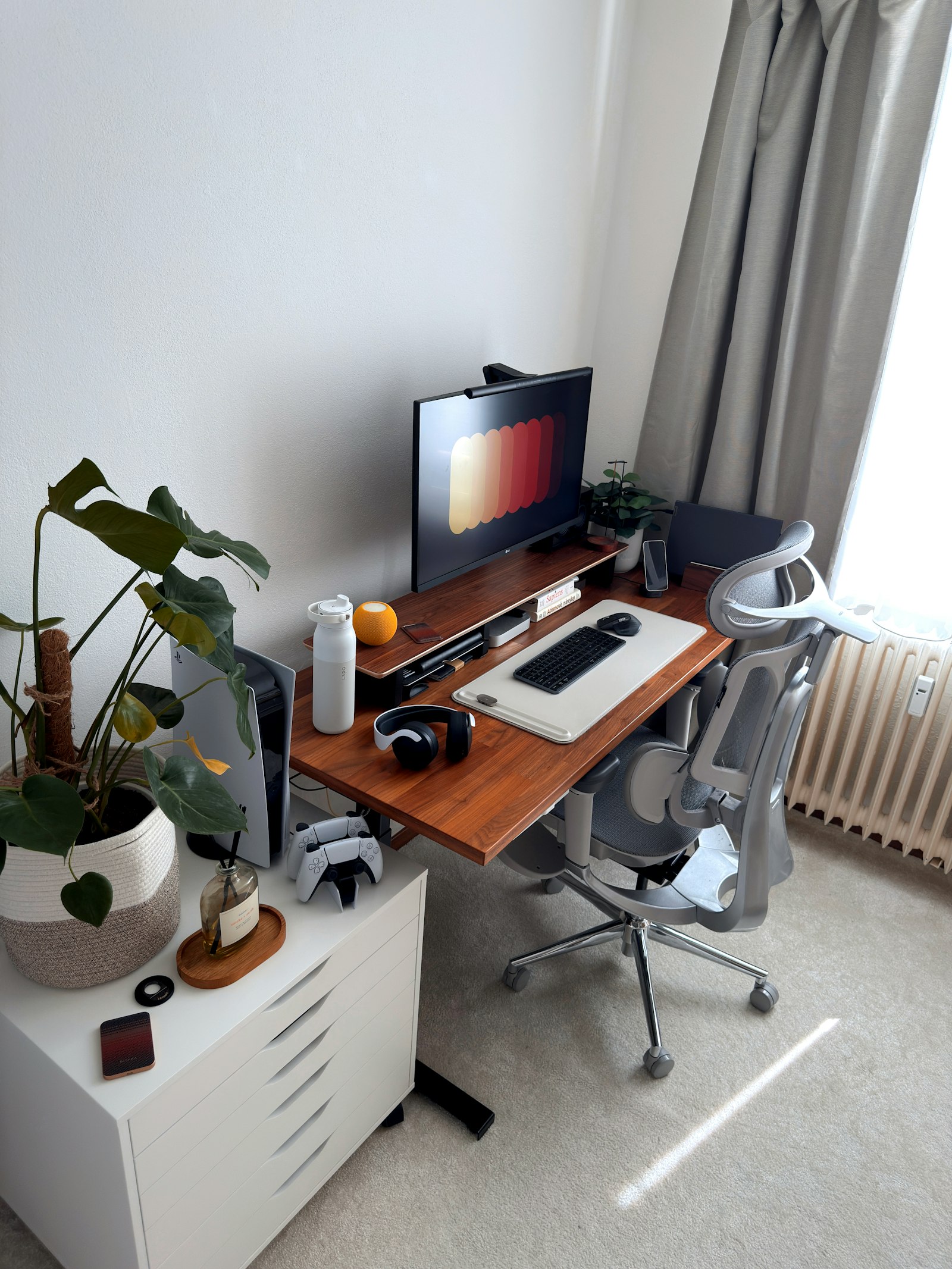

My desk is almost empty. This bothers people who don’t know me.
I have a desk in my home office that’s about 5 feet wide and 30 inches deep. Most people could fill that in a morning. Pens, cable organizers, a phone stand, photos, sticky notes, motivational prints, a little plant that’s slowly dying, three half-empty coffee cups (in my case, half-empty tea cups), notebooks for plans that never happened, a printer that gets used once every two months and takes up as much real estate as a small dog.
I have three objects on my desk.
It’s not minimalism as a aesthetic. It’s not some Instagram performance. It’s a small philosophy that I’ve been testing for about eight years, and it works.
The Discipline of Editing
The rule is simple: every object on your desk or your bedside table or your kitchen counter has to earn its place. Not its utility. Its place. Utility alone doesn’t cut it. A dish doesn’t have to be beautiful to be functional, but if you’re going to look at it eight times a day, it should be at least that.
But more than that, it has to be something you actually use. Not something you might use. Not something you bought because it seemed useful in a moment. Something you touch or see and think about regularly.
Before I learned this, I had a desk like everyone else’s. A graveyard of intentions. A drawer full of pens, half of which didn’t work. A cable tangle that would take a Navy SEAL to sort out. Books I’d meant to read stacked like some kind of literacy insurance policy. Three different organizers all competing to organize things that didn’t need organizing.
The problem was that each item took up cognitive space. Not because I was consciously thinking about them, but because my eye kept landing on them. A pen that doesn’t work is a tiny frustration that compounds. A cable you don’t recognize is a small mystery. A book you haven’t read is a quiet judgment.
The desk felt busy. Which meant my mind felt busy. And I wasn’t any more productive for it.
The Three Objects
So I made a rule. I sat down one afternoon and asked myself: what three things do I actually need on this desk? Not want. Need. In the sense that I touch them or look at them almost every day, and they matter to how I work.
A good pen. Not many pens. One. A Kaweco AL Sport, aluminum, black. I’ve had it for five years. It writes smoothly. It fits my hand. When I pick it up, it feels intentional. I take notes on paper because some part of my brain still works better that way. This pen is the tool for that. It earns its place.
A notebook. Specifically, a Moleskine, black, hard cover. I’ve gone through a lot of them. I write in it almost every day. Thoughts, to-dos, things I heard that stuck with me, ideas that might become something or might disappear. The notebook is where my mind goes when I need to think out loud on paper. It’s the only pile on my desk that’s allowed to exist.
A watch. This one feels less essential, but here’s why it’s there: I don’t wear a watch most of the time. But when I’m at my desk working, I set one down beside me. It’s a vintage Seiko, nothing fancy, keeps good time. I look at it constantly. Not because I’m anxious about time, but because checking a watch is a physical reset. You glance, you see the time, your mind recalibrates. It’s a small anchor. And a watch is beautiful to look at in a way that your phone’s time display is not.
That’s it. Three objects.
Everything Else
Everything else is inside drawers or on shelves. My cables are in a drawer, untangled, labeled. My extra pens are in a cup inside the desk. My books are on the bookshelf, not on the work surface. The small things that pile up, the things you think you need close at hand but really just create visual noise, they have a home that’s not your desk.
It sounds extreme. I get asked about it. And the answer is always the same: the desk isn’t worse for it. The desk is better. Because now when I sit down, there’s space. Physical space, but also mental space. My eye isn’t being pulled in five directions. I don’t have to move three things out of the way to find the thing I actually need.
And weirdly, the three objects themselves become more present. I notice the pen more. I appreciate the notebook more. I actually look at the watch instead of it being part of the static background of stuff.
The Larger Point
The rule works on desks. It also works on kitchen counters, nightstands, and mental real estate. The principle is: if it’s not earning its place, it’s taking up space. And space, especially the space where you actually live and work, is precious.
I’m 51. I’ve accumulated enough stuff to know that more doesn’t make anything better. Better is fewer, chosen, used, cared for. Better is knowing where everything is. Better is being able to see the surface you work on.
It’s not about being austere or punishing yourself. It’s about respect. Respect for your attention, respect for your time, respect for the few objects you actually do need. They deserve not to compete with ten other things for your regard.
My desk is almost empty. And that empty space is the most useful thing on it.