
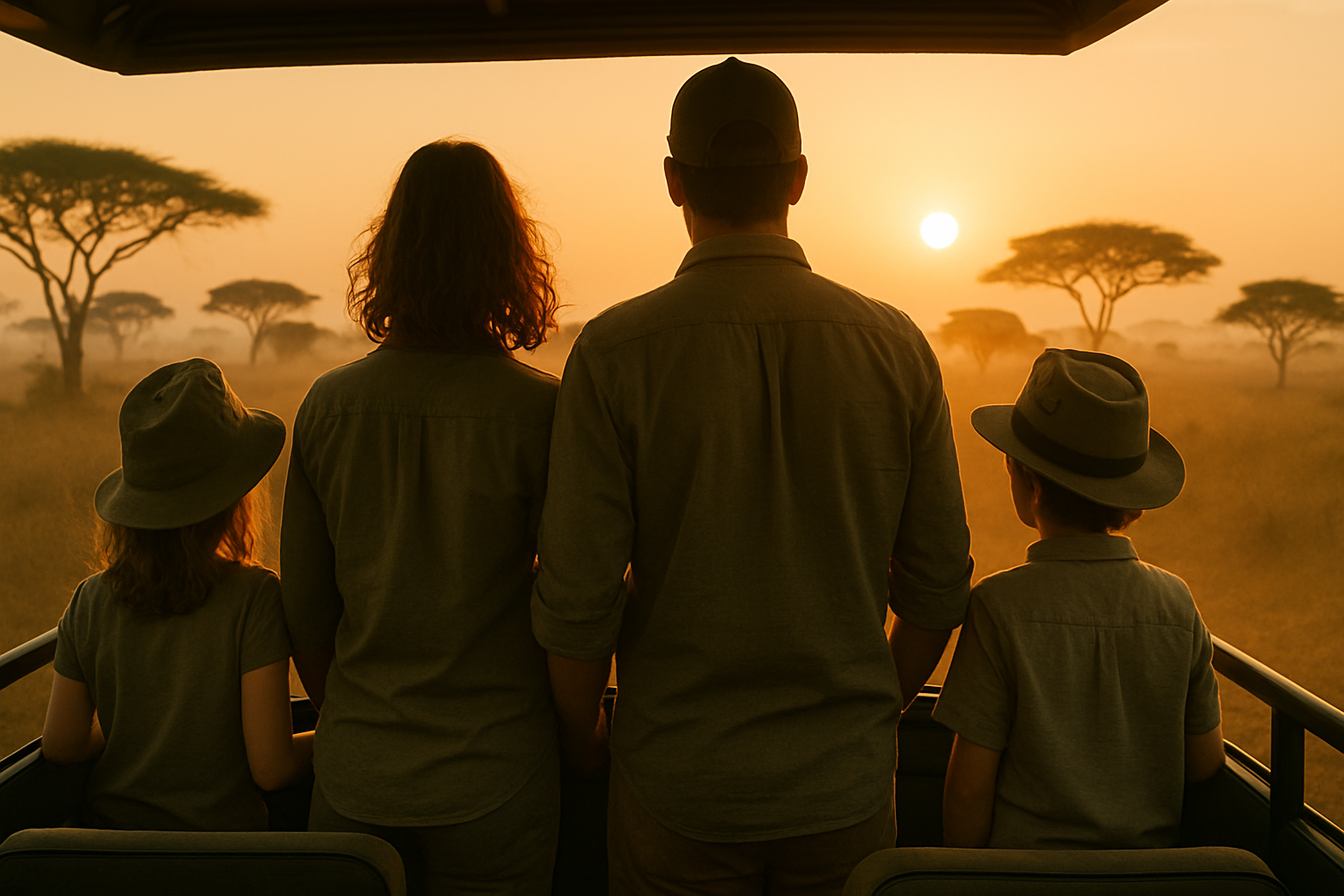

I have been home from our Southern Africa family safari for a few weeks now and I still catch myself at 6 a.m. listening for something.
That is what a safari does to you. You spend two weeks with your ears up, waiting on a sound in the dark, and then you come back to a house in Miami where the loudest thing is the dog barking at the mailman.
We flew Miami to Cape Town, worked our way through South Africa, Zimbabwe, and Botswana, and then closed the whole thing out in the Seychelles. Twenty-four days. Four countries. Five stops. Eleven flights.
If you followed the Instagram series, you got the highlight reel. This is the long version. What we did, what we would do again, what went sideways, and the one thing nobody warned us about that flattened three out of four of us. Plus the packing list at the bottom, which is the part I would have wanted most before we left.
If you are planning a Southern Africa family safari of your own, take the route below and steal whatever is useful. That is why I wrote it all down.
Let’s go.
The Route, Fast
- Cape Town, South Africa. One&Only. 4 nights. City, coast, penguins, sand dunes.
- Kruger (Sabi Sands), South Africa. Sabi Sabi Bush Lodge. 5 nights. The Big 5.
- Victoria Falls, Zimbabwe. Old Drift Lodge. 3 nights. Elephants, cheetahs, the Falls.
- Chobe, Botswana. Chobe Game Lodge. 2 nights. Lions and river cruises.
- Seychelles. Kempinski on Mahé, then Four Seasons Desroches Island. 7 nights. Full stop.
Two chapters. Safari, then reset. That split was on purpose and it is the single best structural decision we made. If you take one thing from this whole post about how to build a Southern Africa family safari, take that. More on it later.
Cape Town: The Warm-Up That Is Actually a Main Event
Most people open a Southern Africa family safari by flying straight to the bush. We started in Cape Town instead, and I probably would do it that way again every time.
We based out of the One&Only for four nights, which was the right call. Cape Town is not a layover city. It deserves real days, and that was the best spot to start from.
Day one we took the boys out to the Atlantis sand dunes on four-wheel ATVs. Jet-lagged, sunburned, screaming through the dunes. If you have teenagers and you need to buy their buy-in for the next three weeks, this is how you do it. You do not open a 24-day trip with a museum.
Day two was Table Mountain, then the Bo-Kaap neighborhood, where the houses are painted in colors that do not exist anywhere else, and the samosas from a corner shop cost about a dollar and ruined me for every samosa since.
Day three was the big one. Chapman’s Peak drive down the coast with stops at an ostrich farm, the Cape of Good Hope (we spotted a caracal on the way in, which our guide said he sees maybe twice a year), African penguins at Boulders Beach, and humpback whales breaching while we ate lunch. We finished at Kirstenbosch Botanical Garden, and walked the tree canopy walkway with an owl watching us the whole way.
Those were just one day itineraries. Cape Town is absurd.
Food-wise, the best meal at the One&Only was ROOI. Nobu on property was strong too, but ROOI is where I would send you hands down. Try the Kudu appetizer. It was delicious.
Cape Town: Do / Don’t
Do:
- Give Cape Town four nights minimum. Three or less is too little.
- Book Table Mountain for a clear morning and check the cable car status the night before. The mountain makes its own weather.
- Drive Chapman’s Peak yourself if you are comfortable on the left. The pullouts are the whole point.
- Get to Boulders Beach early. It is a boardwalk and it fills up.
Don’t:
- Don’t try to stack Cape of Good Hope and Kirstenbosch and Table Mountain into one day. We got lucky with weather. You might not.
- Don’t skip Bo-Kaap because it looks like a photo stop. Go with someone who can tell you the history. It is not decoration.
- Don’t assume the kids will be bored by the botanical garden. Mine were the ones who spotted the owl.
Food and Water: The Part Nobody Warns You About
Here is the section I would have paid money to read before this trip.
Somewhere in Cape Town, we picked up a stomach bug. We had no idea. It did not surface until we were deep in the bush a few days later, and when it did, it took down three of the four of us. I will tell you how that played out in a minute, because it happened at Kruger and it belongs there.
What I want to give you first is the part you can actually act on.
Southern Africa was apparently a hot zone for this. Not malaria, not something exotic. Just bacteria, living in the water and on produce that got rinsed in that water. You will not think about it, because you are staying in beautiful places with beautiful bathrooms and someone is handing you a cold towel. That is exactly why it gets you. Not the locals, but someone who hasn’t come across this before.
I am not a doctor and I am not going to pretend to be one. Talk to a travel clinic before you go, and read the CDC’s food and water guidance for travelers before you book anything. It says most of what I am about to say, in less colorful language, and I wish I had taken it seriously the first time. One thinks about vaccines, but water guidance is just as important. On any Southern Africa family safari this is the single most useful hour of prep you can do.
Here is what we learned the expensive way.
Food and Water: Do / Don’t
Do:
- Use bottled water for everything. Drinking, brushing teeth, rinsing a toothbrush, ice. Everything.
- Water is generally safe to drink, but there is always a risk.
- Pack rehydration salts and an anti-diarrheal. Bring more than you think. Pharmacies are not always where you need them.
- See a travel clinic before you fly and ask directly about traveler’s diarrhea and whether a standby antibiotic makes sense for your family.
- Isolate whoever is still healthy. It felt paranoid. It worked.
Don’t:
- Don’t eat raw fruit or vegetables you did not wash yourself with bottled water.
- Don’t assume a five-star property means five-star water. The bug does not read the brochure.
- Don’t tough it out quietly. Tell your lodge. Sabi Sabi could not have handled it better once they knew.
- Don’t let it scare you off the trip. Three of us got sick and I would still go back tomorrow.
I want to be clear about something. Eating the local food is the point of travel, and I am not telling you to hide from it. I am telling you to be smart about water and raw produce specifically, and go eat everything else.
Sabi Sabi, Kruger: The Best Five Nights of the Trip
Next up was Sabi Sabi Bush Lodge, in the Sabi Sands reserve on the edge of Kruger. Five nights. Even with two of those nights lost to the stomach bug, this was the heart of the trip and my favorite stay of the whole 24 days. If you only have room for one lodge on your Southern Africa family safari, this is the one I would spend the money on.
First night, first game drive, we saw a leopard in the dark. That is not supposed to happen on night one. Leopards are the one everybody chases and the one most people miss.
Over the next few days: rhino. Elephants. Our first mongoose. A hyena that walked right past the truck. Two lionesses at dusk on our way in to dinner. A buffalo herd that had to be five hundred animals, moving through mud that elephants had churned up ahead of them. Wildebeest, kudu, warthogs. A solo lion, just sitting there, owning the entire landscape.
And then one night, back at the lodge, a lion roaring in the dark close enough that you feel it in your chest before you hear it. Nobody said anything. We just sat there.
The food at Sabi Sabi was the best of the trip and it was not close. Exotic game on the menu every night. Kudu, ostrich, zebra. My kids, who negotiate about chicken nuggets at home, ate all of it.
And then the bug we brought from Cape Town finally showed up.
My wife went down first. Then me. Then my youngest. Confirmed gastroenteritis. Three out of four. We put my older son in his own room and quarantined him away from the rest of us, purely to keep him healthy, and he received this news the way you would receive a lottery check. Room to himself, room service, nobody bothering him for two days. He has since described it as the best part of his trip, which tells you everything about teenagers.
It cost us most of two days at the best lodge on the entire trip. We extended a night at Sabi Sabi to claw some of it back, and I am glad we did. Build a buffer night into a trip like this. You will either use it for a bug or you will use it for one more game drive, and both are wins.
The service is what I will actually remember, though. Shoutout to Imelda and to Moses. When we were down, they made a lodge in the middle of the bush feel like somebody’s house. Checking on us, adjusting meals, quietly handling everything without ever making it a thing. That is not something you can put in a brochure.
Sabi Sabi and Safari Lodges: Do / Don’t
Do:
- Stay at least four nights at a real safari lodge. The Big 5 is a numbers game and every drive is a new roll.
- Do the bush walk. Being on foot changes the entire scale of the place.
- Take the night drives. The leopard, the hyena, the roaring lion, all of it happened after dark.
- Tip your ranger and your tracker well and by name. They are the trip.
- Build a buffer night. Ours saved us when we got sick.
Don’t:
- Don’t book a two-night safari and expect the Big 5. You are gambling.
- Don’t spend the drive looking through your phone.
- Don’t talk over your ranger. Half of what they know they will only tell you if you shut up long enough to hear it.
- Don’t skip the game meats because it sounds weird. The kudu is extraordinary.
Zimbabwe: Old Drift Lodge and Victoria Falls
Stop 3 had us flying into Zimbabwe where stayed at Old Drift Lodge on the Zambezi, right on the border with Zambia.
First evening: sunset river cruise. Hippos, crocs, and birds I did not have the vocabulary for until the guide gave me one. Kingfishers, storks, a fish eagle that sounded like the whole continent had a theme song.
Next day was the biggest day of the trip for the boys. We walked with elephants at a preserve, and at the end we fed them by hand. Then a family of warthogs came trotting through like they had been invited. The morning wrapped up with a breakfast with the rangers where we looked at pictures and videos from the walk.
Then we walked with cheetahs. A male and a female. Walked. With cheetahs.
I need to sit on this one for a second, because “walk with cheetahs” sounds like a petting zoo and it is not.
They are leashed. That is the only thing standing between you and the fastest land animal on the planet. And when you get close, the first thing that hits you is that there is nothing soft about them. No house-cat energy anywhere. It is all shoulder and haunch and coiled muscle under a very thin coat, and you can see every fiber of it move when they walk. They are lean the way a boxer is lean, not the way a pet is lean.
The second thing that hits you is that these are not tame. Habituated, yes. Tame, no. Our guides were blunt about it. If a cheetah decides an impala or a warthog or anything else in that field is catchable, it will go. The leash is a formality against an animal that accelerates faster than most sports cars. So you walk on a specific side, you stay behind the shoulder line, you do not crouch, you do not run, and you do not turn your back. Those rules are not theater.
The guides watch the tree line the entire time, not just the cheetahs. That told me more than anything they said out loud.
It is the most alive I felt on the whole trip. Ten out of ten. Just do not walk into it thinking you are going to scratch a big kitty behind the ears.
And then came Victoria Falls, which I saw from the ground and then again from a helicopter, and I still do not have a good sentence for it. You feel the Falls in your sternum before you see them. The locals call it Mosi-oa-Tunya, the smoke that thunders, and after five minutes there you understand that the English name is the worse of the two. We ate at the Lookout Cafe with the gorge dropping away below the table, and we stood next to a baobab tree that has been alive for roughly 1,200 years. That tree was already old when almost everything I know about was invented.
One practical note on the Falls that I did not see anywhere before we went. The trail runs through a series of numbered viewpoints, and the mist is not evenly distributed. Some lookouts are dry. Others will soak you to the bone in about eleven seconds, and I mean drenched, phone-in-a-bag, walking-back-to-the-car-squelching drenched. Here is the tip: if you do not want to get wet, walk it up to viewpoint #8 and turn around. You will still see the Falls properly and you will stay dry. Push past #8 and you are getting the full baptism whether you signed up for it or not.
We went all the way. Worth it. But know what you are choosing.
One regret, and it is the only real planning miss of the trip. We were sitting on the border of Zambia and we did not cross. If I did it again I would build in one night on the Zambian side. Two countries, one border, one extra night.
Zimbabwe and Victoria Falls: Do / Don’t
Do:
- See the Falls from the ground first, then from a helicopter. Ground first. The helicopter is the exclamation point, not the sentence.
- Stop at viewpoint #8 if you want to stay dry. Go past it if you want the full experience. Decide before you start walking, not while you are soaked.
- Bring a dry bag or a waterproof phone pouch, and waterproof jacket. If not you can rent or buy a poncho, but that adds to the day.
- Book the elephant and cheetah walks well in advance. They cap group sizes and they sell out.
- Listen to every word the cheetah guides say. Those rules exist for a reason.
- Eat at the Lookout Cafe. The view does the work.
- Add a night in Zambia if you are staying on the Zimbabwe side. You are already there.
Don’t:
- Don’t do the Falls in the middle of the day if you can help it. Light is better early and the crowds are thinner.
- Don’t wear anything you care about past viewpoint #8. You will get soaked. That is not a figure of speech.
- Don’t bring a cheetah walk to a kid who cannot follow instructions under pressure. These are wild animals on a leash, not an attraction.
- Don’t treat Zimbabwe as a Victoria Falls stopover. There is more here than the waterfall.
Chobe, Botswana: The Lions
Wrapping up the safari portion of the trip for stop 4 was two nights at Chobe Game Lodge, and it delivered the single best hour of the entire trip.
On the drive in, before we had even checked in, we passed giraffes, hippos, and elephants. Botswana does not warm up. It just starts.
The 6 a.m. game drive on our second day is the one I will be talking about for the rest of my life. My wife and I went out alone. First we found a male lion with four cubs. Which was amazing by itself. The cubs were playing on one side, with father watching from the other. As soon as we rolled in, he got up, and took them into the bush. Then the rest of the pride came through behind him. Fourteen lions. Fourteen. And at the back, a lioness with two more cubs walking in her shadow.
Nobody in the vehicle said a word. I did not film most of it. That was on purpose.
That afternoon we did a river cruise with elephants coming down to the water, and then a late game drive that turned into a giraffe parade. Dozens of them. We watched two males fight, swinging their necks like slow hammers, which is somehow both graceful and violent.
That was the end of the safari chapter. We flew out of Botswana and then through Johannesburg with red dust still in our shoes.
Botswana: Do / Don’t
Do:
- Take the 6 a.m. drive. Every time. That is when the cats are still moving.
- Do both a land drive and a river cruise. Chobe from the water is a completely different animal, literally.
- Consider one drive as adults only if your kids will let you. My wife and I got the lion pride to ourselves and it was the most romantic hour of the last decade.
Don’t:
- Don’t give Chobe only two nights like we did. Three would have been right.
- Don’t sleep in. I know. Do it anyway.
- Don’t try to get the perfect photo of everything. Some of it belongs to you, not to the internet.
The Johannesburg Hinge and Getting to the Seychelles
Practical section, but this is the stuff that will actually save you.
There is essentially one flight a day, depending on airline, into Mahé, Seychelles, and connections out of the safari circuit do not line up with it. We flew to Johannesburg, slept at the InterContinental attached to the airport, and flew out the next morning. Five hours from Johannesburg to Mahé.
That overnight was not a wasted day. It was a necessary one. Build it in.
Long-Haul Logistics: Do / Don’t
Do:
- Book the airport hotel in Johannesburg. It is connected to the terminal. Do not be a hero.
- Check Seychelles flight frequency before you build the back half of your itinerary. It will dictate everything.
- Keep one carry-on with a full change of clothes for each person. Eleven flights means eleven chances for a bag to go wandering.
Don’t:
- Don’t book a tight connection anywhere in this itinerary. Small planes, small airports, unpredictable weather.
- Don’t plan an activity for the Johannesburg night. You will not do it.
The Seychelles: The Second Act
Here is the thing I want other travelers to steal from this trip.
Do not end on safari.
Safari is incredible and it is also work. Early alarms, long drives, constant stimulation, kids at full attention for two straight weeks. If you fly home straight from a game lodge you land exhausted and the whole trip blurs into one adrenaline smear.
We gave ourselves a second act instead. Seven nights in the Seychelles with no agenda whatsoever. Granted not everyone can do this, but definitely try to end with something fun and relaxing that the kids can enjoy.
Two nights at the Kempinski on Mahé to decompress. First night we ate dinner and went to bed and that was the entire plan. Day two was pure beach. We hit biodegradable golf balls into the ocean that break down and feed the fish. We watched giant tortoises do absolutely nothing at a very high level. We watched fruit bats fly over in broad daylight. We played sand volleyball. We ate on the beach. There is a tire swing there that my kids fought over like they were six years old again.
Then a prop plane to Desroches Island and four nights at the Four Seasons, in a two-bedroom villa right on the beach. We rode bikes everywhere. We snorkeled two full days and saw sea turtles, rays, coral, and more fish than I can name. Paddleboards, kayaks. We ate on the beach. We ate in a lighthouse. At night the shearwater birds cried like something out of a horror movie, and one of them flew directly into my wife’s bike, which is now permanent family folklore.
That is it. That was the whole itinerary. It was perfect.
Timing forced us back to Mahé for one more night at the Kempinski before the long road home. Mahé to Johannesburg, Johannesburg to Atlanta, Atlanta to Miami.
Seychelles: Do / Don’t
Do:
- Structure your trip in two acts. Adventure, then decompression. Do not skip the second one.
- Snorkel more than once. Day one you are learning. Day two you are seeing.
- Take the villa with the extra bedroom if the budget allows. After three weeks together, a door matters.
- Eat at every restaurant on the property. Take advantage of the free breakfast!
Don’t:
- Don’t overschedule the island half. The lack of agenda is the product.
- Don’t assume you can island-hop easily. Flights are limited and prop planes have real weight limits.
- Don’t book Desroches for two nights. Four was right. Three is the floor.
What to Pack, and What Not to Forget
This is the Southern Africa family safari packing list I wish somebody had handed me before we left. Everything here earned its space.
The stuff people forget:
- Binoculars. One pair per person. This is my number one. Sharing a pair on a game drive is a special kind of misery. This is the single highest-impact thing in your bag.
- Warm layers. Everybody packs for hot Africa. Nobody packs for a 5:30 a.m. open-vehicle game drive in winter. It is genuinely cold. Fleece, beanie, gloves. I am not exaggerating.
- Universal charging adapters, plus a multi-port block. South Africa uses its own plug type that is not the standard European one. Bring more adapters than rooms you will sleep in.
- A power bank. Multiple. Game drives are long and lodges sometimes run on generators.
- Rehydration salts and a small medical kit. See the sickness section. Learn from us.
- Bottled water discipline. Not an item. A habit. Pack it in your brain.
The safari kit:
- Neutral colors. Khaki, olive, tan. No bright white, no black, no blue (tsetse flies are drawn to dark blue and black).
- Broken-in closed-toe shoes for bush walks.
- Wide-brim hat and real sunscreen.
- Sunglasses, and a spare pair.
- A buff or scarf for dust.
- A soft duffel, not a hard suitcase. Bush plane luggage limits are strict and often soft-sided only. Check with every lodge.
- A camera with real zoom if you care about photos. Your phone will not reach that leopard.
The beach kit:
- Reef-safe sunscreen.
- UPF swim shirts for the kids.
- A cheap underwater camera. I used my GoPro, but a cheap camera will do just fine.
- Water shoes for coral.
- Motion sickness meds for the prop plane and the boats.
What I overpacked:
- Too many pairs of shoes. Bush shoes, beach shoes, one nice pair. That is all you need.
- Too much “safari-looking” clothing. Lodges do laundry. Pack half.
Questions I Got Asked 40 Times
Is a Southern Africa family safari safe with kids?
Yes. The lodges are professional, the rangers are extraordinary, and the rules are clear. The thing that actually got us was a stomach bug, not an animal.
How young is too young?
Most Big 5 lodges set a minimum age for game drives, often around six. Check the specific lodge. Ours were teenagers and that was ideal, old enough to be patient and young enough to be genuinely stunned.
Do you need malaria pills?
Depends on the region and season. Ask a travel clinic. We did, but do not ask the internet, and do not ask me.
Was 24 days too long?
No. And I would not shorten it. But I would not do 24 days of safari either. The two-act structure is what made the length work.
What was the favorite?
Sabi Sabi. Not close. Best food, best service, best rangers, and the place we got sick and got taken care of.
What I Would Do Differently
- Add a night in Zambia. We were standing on the border. Two countries for the price of one extra night.
- Three nights at Chobe instead of two. The lion pride made the case for us.
- Take the food and water thing seriously from day one. We lost two days of the best lodge on the trip.
- Bring binoculars for everyone. I will keep saying it.
Would We Do It Again
Immediately. Tomorrow. Same route, four small fixes. A Southern Africa family safari is a lot of trip to take on, and it is worth every hour of the planning.
Twenty-four days, four countries, eleven flights, one stomach bug, seventeen lions, one 1,200-year-old tree, and two teenagers who complained about the 5 a.m. wake-ups every single morning and then talked about the lions for the entire flight home.
That is the whole thing right there. They complain and they remember. Both. Every time. If you are waiting for a version of family travel where nobody grumbles, you are going to wait forever and miss the trip.
Go. Pack the binoculars. Drink the bottled water.
Pops out.
Free Download: The WCP Africa Family Safari Packing Checklist
One page, everything we actually used on our Southern Africa family safari across 24 days, 4 countries, and 11 flights. Including the stuff nobody tells you to bring.